
z/OS
z/OS is a powerful IBM mainframe operating system designed for large-scale, high-volume and secure workloads. Known for its stability and availability, z/OS supports mission-critical applications that require nonstop performance.
Benefits
Mesh mainframe workloads with modern orchestration
Align z/OS scheduling with today’s automation strategies.
Unify scheduling
Integrate batch jobs into end-to-end enterprise workflows.
Control costs
Reduce MIPs usage by offloading scheduling from z/OS.
Modernize execution
Get advanced scheduling logic and centralized control.
Enterprise workload automation for z/OS
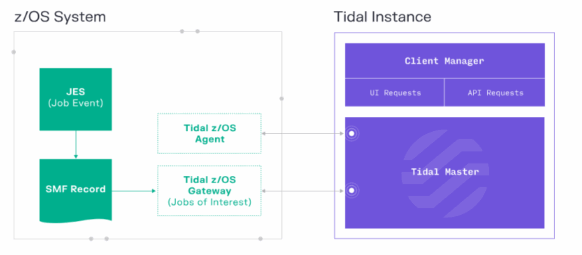
Tidal’s z/OS integration consists of a native agent running in the z/OS Unix System Services (USS) environment, plus an optional Gateway component that monitors lifecycle via System Management Facility (SMF) records.
With Tidal’s z/OS agent, you can orchestrate native z/OS processes and IBM Workload Scheduler for z/OS (formerly Tivoli Workload Scheduler) jobs as part of your enterprise automation strategy. This pairing upgrades traditional mainframe job automation into an intelligent, enterprise-wide orchestration layer.
What the integration enables
The Tidal z/OS agent enables you to
- Automate dataset arrival checking and console interactions
- Capture system output (SYSOUT), condition codes and SMF logs
- Execute console commands and USS shell scripts
Integrate z/OS scheduling with Unix, Windows, cloud and more - Monitor file events and dataset arrivals
- Orchestrate workloads across sysplex regions
- Submit and monitor z/OS batch and Job Control Language (JCL) jobs
Offload mainframe scheduling
Managing z/OS mainframe processes is a business-critical effort. As organizations incorporate a growing number of applications on a range of distributed devices, it’s important to manage them centrally and avoid islands of automation. When you offload scheduling from the mainframe, you can reduce your mainframe operating costs.
With Tidal’s z/OS integration, you can orchestrate mainframe job scheduling in Job Entry Subsystem (JES) within overall business processes for end-to-end management and automation.
How it works
Tidal acts as the central controller for your distributed and mainframe job schedules.
- Incorporates fault tolerance capabilities to enhance the reliability and availability of job execution. It monitors job progress, captures SYSOUT and maintains a comprehensive job log that includes details such as return codes, error codes and completion status
- Leverages initialization statements to set values and configurations specific to job execution. Variable tables enable definition and variable substitution within job steps, enhancing flexibility and customization
- Offers a Dynamic Workload Console, a web-based dialog that provides administrators with real-time visibility to provide job tracking and identify critical paths within job streams
- Provides a wide range of parameters and options to simplify the process of defining and managing job dependencies, submission and execution
- Specifies workstation names and time zones as well as TSO access to coordinate global teams
- Supports sysplex environments, facilitating job execution across multiple system images
- Tailors interfaces, assists with job definitions and configures subsystem names and options (OPCOPTS) for a customized experience, all within user-friendly ISPF panels
With its extensive capabilities and customization, Tidal empowers organizations to streamline operations, ensure reliable job execution and maximize productivity in the z/OS environment.
More Tidal integrations
Resources
Build a future-proof automation fabric
From legacy systems to modern cloud, Tidal brings it all together.
Tidal and z/OS integration FAQs
-
What is z/OS used for?
z/OS is a widely used mainframe operating system designed for stable, secure and continuously available environments, primarily used for running mission-critical applications on IBM z/Architecture mainframe computers. It's a 64-bit operating system that supports various applications, including web- and Java-based applications and the legacy COBOL language.
-
What does the Z in z/OS stand for?
The "Z" in z/OS, an IBM mainframe operating system, stands for "zero downtime.” This reflects the system's architecture, which is designed for high availability and continuous operation, including components that can quickly failover in case of an issue.
-
How does z/OS work?
z/OS, a mainframe operating system, manages complex workloads by using virtual storage, workload management and address spaces. It divides work into pieces, allows concurrent execution of jobs and manages resources efficiently. z/OS is designed for high availability and security, making it suitable for mission-critical applications.